I am posting this as I think it is necessary. I feel most of today's India don't even know what are our great scriptures are. Even a week ago, I also didn't know all about it. So I felt, it will be good for general awareness and I encourage my blog readers to make a link to this post or copy this post to their own blogs, so that people at least know about the wealth our country has given to the world :)
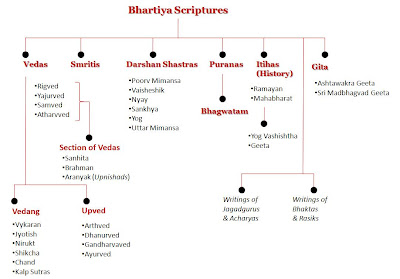
1. Vedas: There are four Vedas. According to to the Muktikopnishad they had 21, 109, 1,000 and 50 branches (Total of 1180 branches).
a. Rigved
b. Yajurved
c. Samved
d. Atharvaved
2. Vedangas: There are six Vedangas (parts of the body of the Vedas):
a. Vyakaran: Science of Grammer.
b. Jyotish: Science of Astrology.
c. Nikrukt: Detailed dictionary of vedic words.
d. Shikcha: Science of pronunciation.
e. Chand: Poetry of Vedas.
f. Kalp Sutras: Vedic Dharma
3. Upveds: There are four upveds:
a. Arthved (science of sociology and economics) is related to Rigved.
b. Dhanurved (science of defense and war and the making of its related appliances) is related to Yajurve.
c. Gandharvaved (science of music, both singing and instrumental) is related to Samved.
d. Ayurved (the medical science) is related to Atharvaved
4. Upnishads: There were 1,180 Upnishads, related to 1,180 branches of the Vedas. Out of them eleven are prominent Upnishads. The Upnishads tell about the illusive nature of the world, introduce a correct understanding about the soul and God and they normally use the term brahm or a pronoun for all the forms of God. The 11 principle upnishads are Aitareya, Brhadaranyaka, Taittiriya, Chandogya, Kena, Isa, Svetasvatara, Katha, Mundaka, Mandukya, Prasna.

1. Vedas: There are four Vedas. According to to the Muktikopnishad they had 21, 109, 1,000 and 50 branches (Total of 1180 branches).
a. Rigved
b. Yajurved
c. Samved
d. Atharvaved
2. Vedangas: There are six Vedangas (parts of the body of the Vedas):
a. Vyakaran: Science of Grammer.
b. Jyotish: Science of Astrology.
c. Nikrukt: Detailed dictionary of vedic words.
d. Shikcha: Science of pronunciation.
e. Chand: Poetry of Vedas.
f. Kalp Sutras: Vedic Dharma
3. Upveds: There are four upveds:
a. Arthved (science of sociology and economics) is related to Rigved.
b. Dhanurved (science of defense and war and the making of its related appliances) is related to Yajurve.
c. Gandharvaved (science of music, both singing and instrumental) is related to Samved.
d. Ayurved (the medical science) is related to Atharvaved
4. Upnishads: There were 1,180 Upnishads, related to 1,180 branches of the Vedas. Out of them eleven are prominent Upnishads. The Upnishads tell about the illusive nature of the world, introduce a correct understanding about the soul and God and they normally use the term brahm or a pronoun for all the forms of God. The 11 principle upnishads are Aitareya, Brhadaranyaka, Taittiriya, Chandogya, Kena, Isa, Svetasvatara, Katha, Mundaka, Mandukya, Prasna.
5. Shruti (means heard): is a term that describes the sacred text comprising the central canon of Hinduism and is one of the three main sources of dharma. The Shruti scriptures are of divine origin, whose truths were directly revealed to ancient rishis (sages) in their deep meditations.
6. Smriti (means remembered): It is collection of codes related to the social living. The Smriti scriptures are of human origin and were written to explain the Shruti writings and make them understandable and meaningful to the general population.
7. Darshan Shastras: Darshan means vision (of reality). In Indian vedic system, the reality of life have been perceived from six different dimensions and that has taken the form of distinct doctrines or six different schools of philosophy called Darshan Shastras. These school strives for liberation of soul by using different means. For details please see the separate post on Darshan Shastras below.
8 Puranas: The scriptures are of human origin and were written to explain the general feature of all the Puranas that they fully explain the creation aspect and also the dissolution aspect of the universe, give the description of all the Manus and tell the history. There are 18 Puranas: Brahm Puran, Padm Puran, Vishnu Puran, Vayu Puran, Bhagwat Maha Puran, Narad Puran, Markandeya Puran, Agni Puran, Bhavishya Puran, Brahm Vaivart Puran, Ling Puran, Varah Puran, Skand Puran, Vaman Puran, Kurm Puran, Matsya Puran, Garud Puran and Brahmand Puran.
9. Bhagwatam: It is Sanskrit for "The Book of God". Its primary focus is the process of bhakti, which is Sanskrit for "Union with God through devotion for Him", in which Krishna is unequivocally declared to be Svyam Bhagwan.
10. Itihas: Ramayan and Mahabharat are called the ithihas (history) books because, along with regular description of their own topic, they also tell a lot about the general history of that period.
11. Yog Vashishtha: It is said that this book alone can lead to spiritual liberation. The profound conversation between Sage Vasistha and Prince Rama is of that between a great enlightened sage and a seeker who is about to reach completeness. This is amongst those rare conversations which directly leads to Truth. The truths, wonders and mysteries of Reality are revealed in a fabulous and grandiose way by Sage Vasistha. From time immemorial until now, this scripture is a well of wealth from which several understandings, scientific ideas, philosophies and perceptions have been realised.
12. Ashtawakra Geeta: Ashtavakra Gita presents the traditional teachings of Advaita Vedanta a clarity and power very rarely matched. It states one's true identity can be found by simply recognizing oneself as Pure Existence and that as individuals we are the Awareness of all things. H H Sri Sri Ravi Shankar (Guruji) has given commentary on Ashtawakra Geeta and these commentaries are available as 33 videos. It is one of most amazing knowledg one can get for jumping into deeper states of awareness and liberation. Benefits guaranteed.
13. Sri Madbhagwat Geeta: It is the practical guide that gives the true knowledge of God and God realization.
This is the best I could search and understood. All are welcome to add their comments and help each other to understand this wealth of knowledge.
All glory to Gurudev.
Jai Gurudev


Comments
Thank You
Jai Gurudev!
Do check my other blog www.aparnata.wordpress.com
Your posting on scriptures gives an hierarchical understanding of the scriptures!
JGD
POOJA
http://iitdpooja-eureka.blogspot.com/
And you are right, most Indians are mostly unaware of this classification - myself included until reading this.
Jai Guru Dev
JGD !
JGD
was just thinking... if we talk about ancient scriptures, we say Vedas first... but we actually focus studies on Geeta, bhagavatam, ayurveda, etc...
I wonder why?
I hope it answer your question
I had this wonder myself, for how many things are out there and is there a clear classification in which all can be put. It turns out that they can be classified afterall.. amazing considering they have evolved in different time and space and style too. Lots get clarified from your post. Thanks for the effort.
A couple of things I still wonder - Is there a pattern in these classifications. For instance what makes a upnishad a upnishad and not a purana or vedangas. etc. What makes veda a veda, interestingly, I did not know if veda was not very appropriate for seekers on path. any particulars on that? Also, is there a time-line or place or origin associated to these scriptures?
Hey, Good work putting them together again.
JGD
MANISH